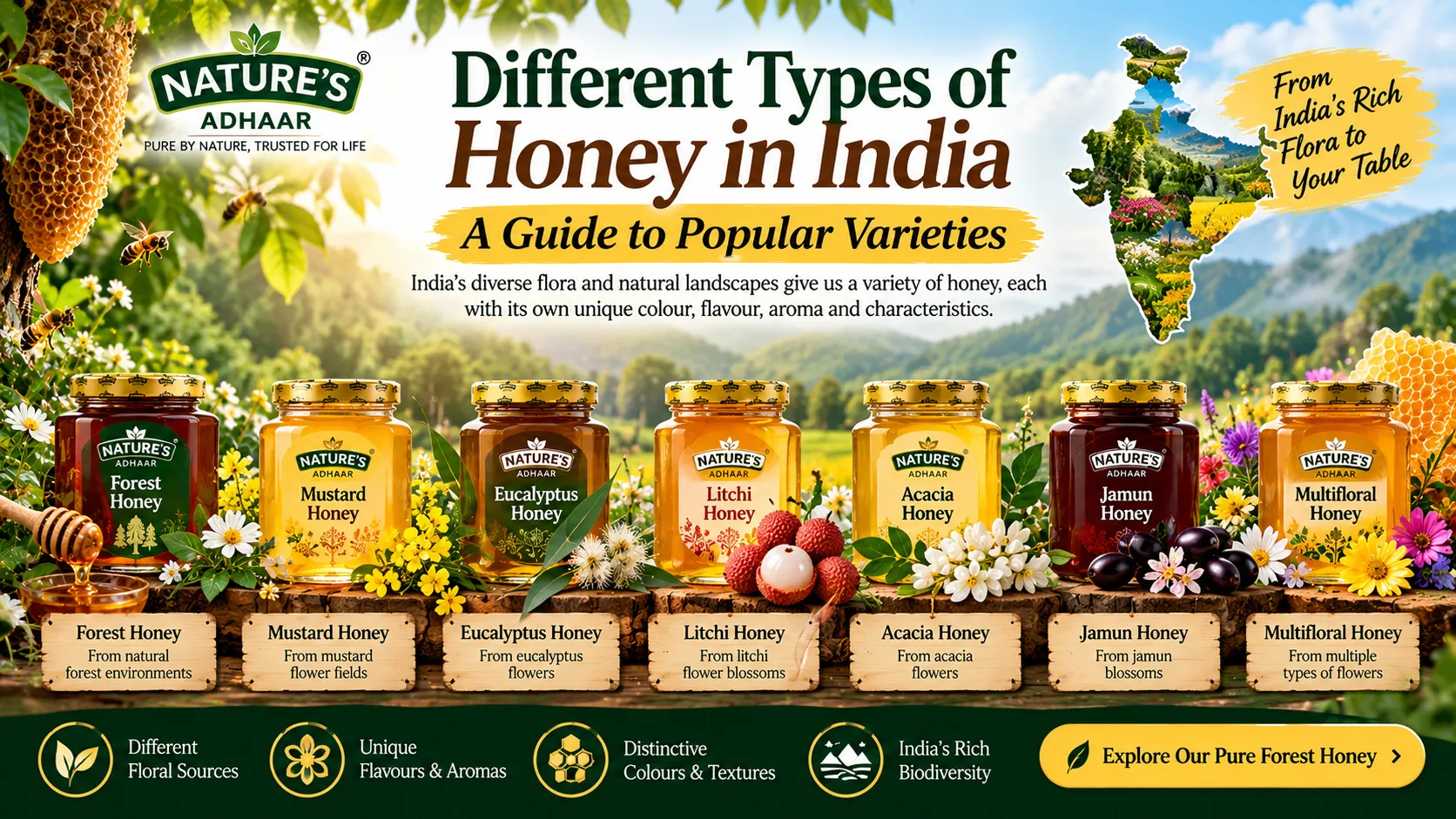
Different Types of Honey in India: A Guide to Popular Varieties
India has a rich variety of flora, landscapes and climatic conditions, making it possible to find honey with different natural characteristics across the country.
From forest honey collected in wild environments to honey associated with specific flowers and agricultural regions, different types of honey can vary in colour, aroma, flavour and texture.
But what makes one honey different from another?
In this guide, we explore some popular types of honey found in India and understand what makes each one unique.
What Makes Different Types of Honey Different?
The characteristics of honey are influenced by several factors, including:
- Floral and botanical source
- Geographical location
- Season
- Climate
- Nectar collected by bees
- Processing and handling
This is why honey from different sources may not look or taste exactly the same.
1. Forest Honey
Forest honey is associated with honey collected from bees foraging in natural forest environments.
Forests can contain a diverse range of wild plants and flowers. As bees collect nectar from different available flora, the resulting honey can have a distinctive and complex flavour and aroma.
Forest honey may naturally vary in:
- Colour
- Taste
- Aroma
- Texture
At Nature’s Adhaar, our Pure Forest Honey is presented as raw, unfiltered and unprocessed, with its story connected to natural forest environments.
2. Mustard Honey
Mustard is widely cultivated in India, particularly across northern agricultural regions.
When bees collect nectar predominantly from mustard flowers, the resulting honey is often associated with a characteristic floral aroma and flavour.
Mustard honey can have a relatively light colour and a distinctive taste that makes it popular among honey consumers.
3. Eucalyptus Honey
Eucalyptus trees are found across different parts of India.
Honey associated with eucalyptus flowers can have a distinctive aroma and flavour. Its colour and texture can vary depending on the specific floral source and other environmental factors.
Like other varieties, its characteristics can change naturally from season to season.
4. Litchi Honey
Litchi is an important fruit crop in several parts of India.
During the flowering season, bees can collect nectar from litchi flowers, producing honey associated with the litchi floral source.
Litchi honey is known for its characteristic floral aroma and pleasant sweetness.
5. Acacia Honey
Acacia honey is associated with nectar from acacia flowers.
It is often recognised for its relatively mild flavour and lighter appearance. However, the exact colour, taste and consistency can vary depending on the source and conditions.
6. Jamun Honey
Jamun is a well-known Indian fruit tree and is found in many parts of the country.
Honey associated with jamun blossoms can have a distinctive floral character and darker appearance compared with some lighter honey varieties.
Its flavour profile can vary according to the floral source and harvesting conditions.
7. Multifloral Honey
Multifloral honey comes from nectar collected from multiple types of flowers rather than predominantly from one floral source.
Because bees may forage across several plants, the flavour, aroma and colour can be influenced by the combination of available flowers.
This makes multifloral honey different from honey associated primarily with one specific floral source.
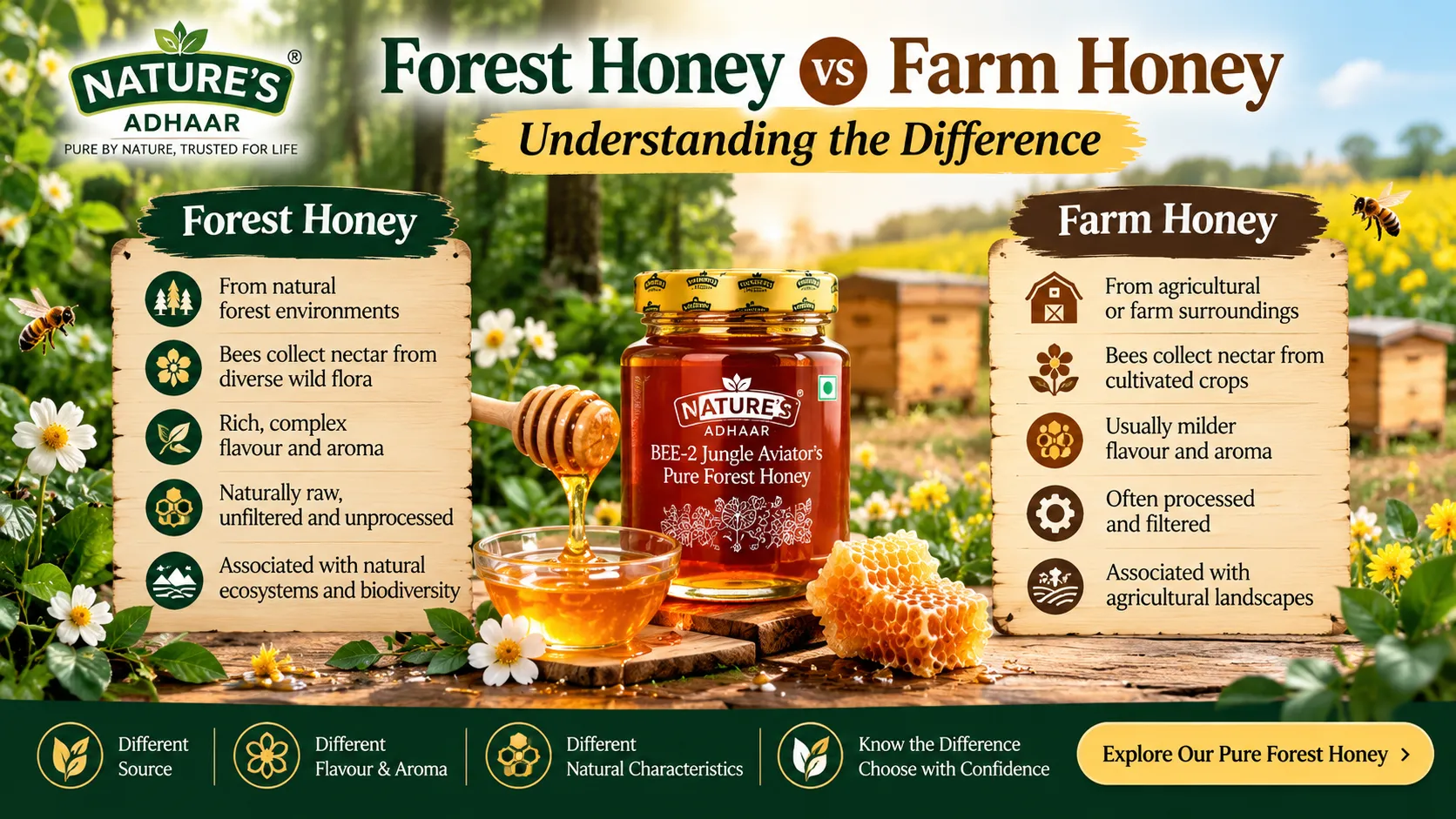
Forest Honey vs Floral Honey
One useful way to understand honey varieties is to consider their source.
Forest honey is associated with diverse natural forest environments, where bees can forage among different wild plants.
Floral or monofloral honey, on the other hand, is generally associated with nectar predominantly coming from a particular flowering plant or crop.
Neither should be judged simply by colour or thickness. Natural characteristics can vary between batches and seasons.
Does Honey Colour Tell You Its Type?
Not always.
Honey can range from very light golden shades to darker amber tones.
Its colour can be influenced by:
- Floral source
- Geographic origin
- Season
- Natural composition
- Storage conditions
Therefore, colour alone should not be used to determine the quality or purity of honey.
Why Does Honey Taste Different?
Just like fruits and flowers have different flavours, honey can also develop different flavour and aroma characteristics depending on the nectar collected by bees.
For example, honey associated with different floral sources may have:
- Mild or strong floral notes
- Different levels of sweetness
- Distinct aromas
- Different textures
This natural variation is one of the interesting characteristics of honey.
How to Choose the Right Honey?
There is no single type of honey that everyone has to choose.
Instead, consider what matters to you:
🌿 Prefer a natural forest source?
You may want to explore forest honey.
🌸 Interested in floral varieties?
Look for honey associated with specific floral sources such as mustard, litchi or eucalyptus.
🍯 Prefer a combination of floral sources?
Multifloral honey may be an option to explore.
Most importantly, read the product label and understand its source, ingredients, processing information and other product details before purchasing.
Why Source Matters
The source of honey is an important part of understanding its natural characteristics.
At Nature’s Adhaar, our Pure Forest Honey focuses on the connection between honey and its natural forest environment.
Our product is labelled:
RAW • UNFILTERED • UNPROCESSED
We believe that understanding the journey of honey—from its natural source to the jar—helps consumers make more informed choices.
Final Thoughts
India offers a fascinating variety of honey, with different types influenced by floral sources, forests, geography, seasons and natural conditions.
From forest honey and mustard honey to litchi, eucalyptus, acacia, jamun and multifloral honey, each variety can have its own distinctive characteristics.
The next time you buy honey, don’t just look at the colour or sweetness. Look at its source, understand its characteristics and read the product information carefully.
🍯 Explore Nature’s Adhaar Pure Forest Honey
Raw • Unfiltered • Unprocessed
🌐 naturesadhaar.in
FAQ
What are the different types of honey in India?
Popular varieties include forest honey, mustard honey, eucalyptus honey, litchi honey, acacia honey, jamun honey and multifloral honey.
Which honey has the strongest flavour?
Flavour depends on the floral source, geographical origin and other natural factors. Different varieties can have noticeably different flavour profiles.
Is forest honey different from floral honey?
Forest honey is associated with natural forest environments and diverse wild flora, while floral honey may be associated predominantly with a particular flowering plant or crop.
Does the colour of honey indicate its type?
Colour can provide clues about honey’s natural characteristics, but it is not enough by itself to determine the exact source or quality.
Why does honey crystallise?
Crystallisation is a natural process that can occur in honey. The rate can vary depending on its natural composition, floral source and storage conditions.
📌 Our Website Honey Blog Sequence
- ✅ Forest Honey: Nature’s Sweet Gift from the Wild
- ✅ Raw Honey vs Processed Honey: What’s the Difference?
- ✅ How to Identify Pure Honey: Common Myths and Facts
- 🆕 Different Types of Honey in India: A Guide to Popular Varieties
Leave a Reply