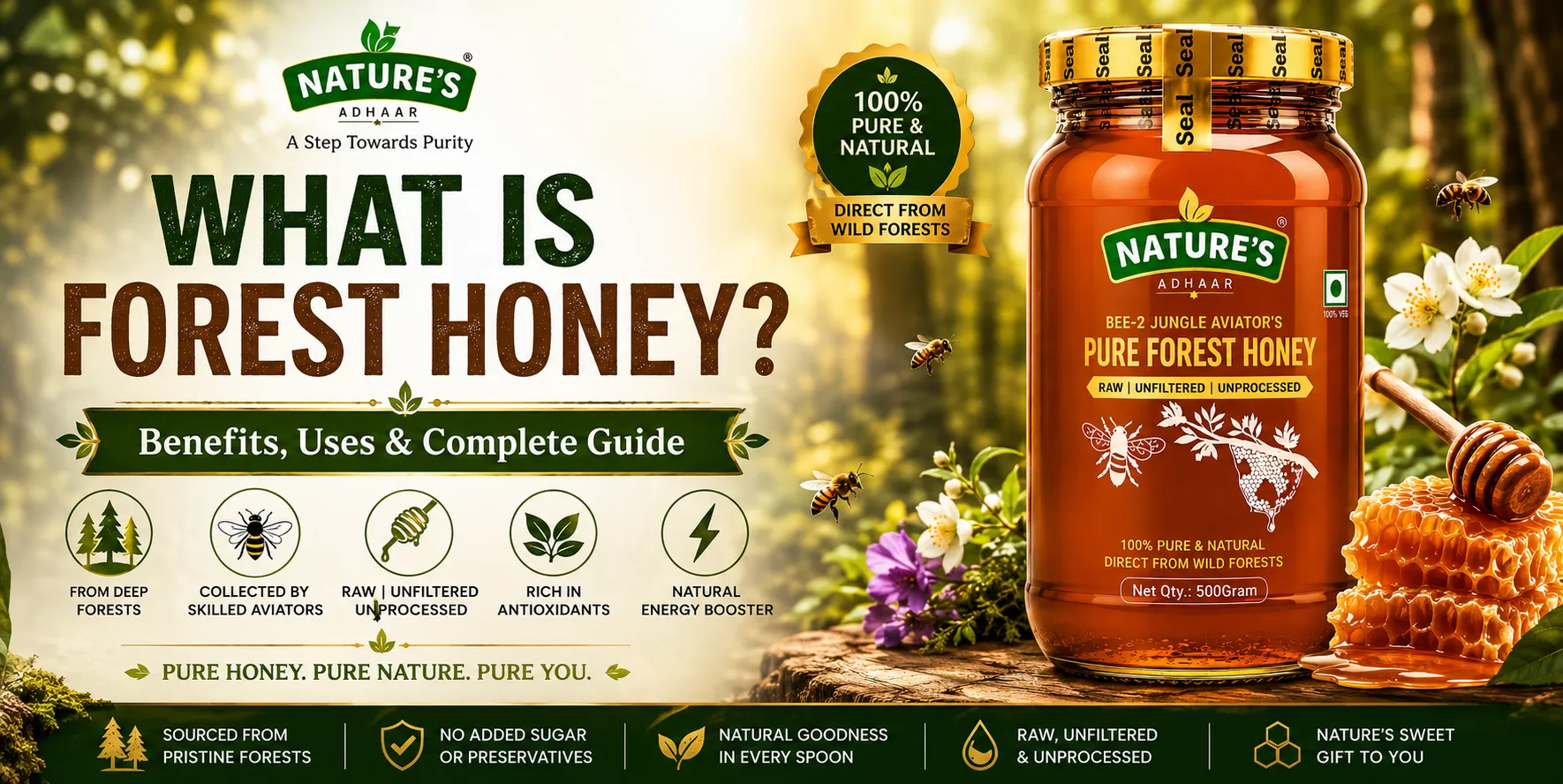
What is Forest Honey? Benefits, Uses & Complete Guide
Honey has been valued for generations as a natural sweetener and traditional food. But not all honey comes from the same environment or has the same natural characteristics.
Forest Honey is associated with honey produced by bees that forage among the diverse flowers, plants, herbs and trees found in natural forest environments. Because the available floral sources can vary by location and season, Forest Honey can naturally differ in colour, aroma, flavour and texture.
But what is Forest Honey, how is it produced, what are its benefits, and how is it different from regular honey?
In this complete guide, we will explore everything you need to know about Forest Honey, including its source, benefits, uses, purity, crystallisation and storage.
What is Forest Honey?
Forest Honey is honey collected by bees that forage on flowering plants and vegetation found in or around forest environments.
Bees visit flowers to collect nectar and carry it back to their hive. The nectar then undergoes natural transformation inside the hive before becoming the honey that is stored in honeycomb.
The simple journey is:
Forest Flowers & Plants → Bees → Nectar → Hive → Honey
Unlike honey associated with a single cultivated crop, forest environments can provide bees with access to a wide variety of natural floral sources.
This diversity can contribute to the distinctive character of Forest Honey.
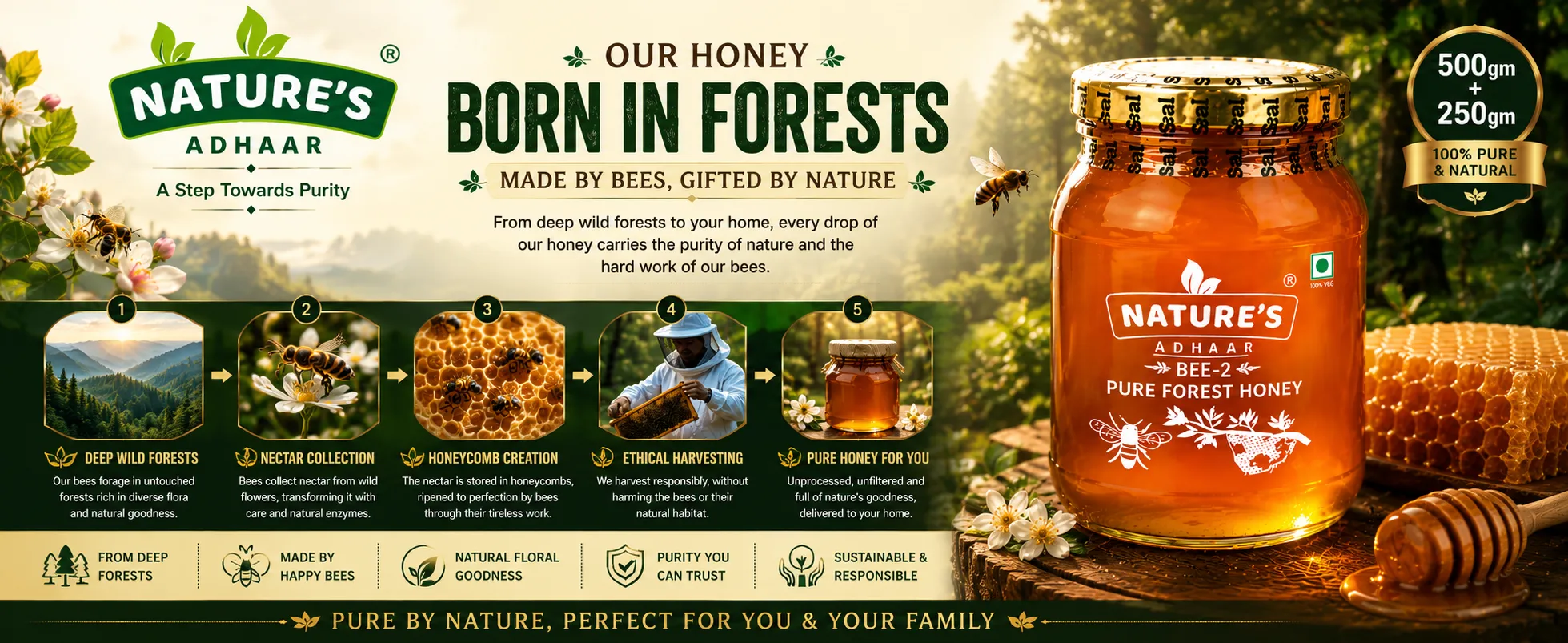
How is Forest Honey Produced?
The production of honey is a fascinating natural process carried out by bees.
1. Bees Collect Nectar
Worker bees travel from the hive and visit flowering plants to collect nectar.
In forest environments, bees may have access to flowers from many different plants, shrubs and trees.
2. Nectar is Carried to the Hive
The collected nectar is carried back to the hive by worker bees.
3. Natural Transformation Takes Place
Inside the hive, the nectar undergoes natural enzymatic changes and its moisture content is reduced.
4. Honey is Stored
The transformed honey is stored inside honeycomb cells.
5. Bees Seal the Honeycomb
Once the honey reaches the appropriate stage, bees seal the honeycomb cells with beeswax.
This natural process results in the honey we eventually collect and consume.
What Makes Forest Honey Different?
The main characteristic of Forest Honey is its connection with a diverse natural foraging environment.
Forest areas can contain many different flowering plants and trees. Depending on the location, season and available flora, the honey produced by bees can naturally have different:
- Colours
- Flavours
- Aromas
- Textures
- Sweetness profiles
This natural variation is completely normal.
Two batches of Forest Honey may not always look or taste exactly the same, because the floral sources available to bees can change throughout the year.
Forest Honey vs Regular Honey
“Regular honey” is a broad term that can refer to honey obtained from different sources and processed in different ways.
Forest Honey specifically relates to the natural foraging environment of the bees.
| Feature | Forest Honey | Regular Honey |
|---|---|---|
| Source | Forest or natural vegetation | Source can vary |
| Floral Diversity | Often diverse | Depends on source |
| Flavour | Can vary naturally | Depends on floral source |
| Colour | Naturally variable | Can vary |
| Aroma | Influenced by floral sources | Depends on source |
| Processing | Depends on producer | Depends on producer |
Therefore, the word “Forest” alone should not be treated as a guarantee of purity or quality. Consumers should also check the product’s sourcing, ingredients, handling and quality information.
Benefits of Forest Honey
Honey is primarily a source of naturally occurring sugars and energy. It can also contain small amounts of naturally occurring compounds influenced by its botanical source.
However, honey should be considered a food and sweetener, not a medicine.
Here are some practical reasons people choose natural honey.
1. Natural Sweetener
Forest Honey can be used as a natural sweetening ingredient in many foods and beverages.
You can add it to:
- Oats
- Yogurt
- Smoothies
- Toast
- Breakfast bowls
- Homemade dressings
- Selected desserts
2. Naturally Distinctive Flavour
Forest Honey can have a unique flavour profile depending on the plants from which bees collected nectar.
Some batches may have a mild floral character, while others may have a deeper and more pronounced taste.
3. Source of Dietary Energy
Honey contains naturally occurring carbohydrates, mainly sugars such as glucose and fructose.
These carbohydrates provide dietary energy.
Because honey is still a concentrated source of sugar, moderation is important.
4. Versatile Food Ingredient
Honey can be used in many everyday recipes.
It can be combined with fruits, nuts, yogurt, oats and suitable beverages or incorporated into cooking and baking recipes.
What is Raw Forest Honey?
Forest Honey and Raw Honey are not exactly the same term.
Forest Honey generally describes the environment where bees forage.
Raw Honey generally refers to honey that has undergone limited processing after extraction, depending on how the producer defines and handles the product.
Therefore, a honey product could potentially be described using both terms if its sourcing and processing meet the relevant criteria.
Always check the product label and manufacturer’s information to understand exactly what is meant by “raw” or “unprocessed.”
Does Forest Honey Crystallize?
Yes, Forest Honey can naturally crystallize.
Crystallisation happens when some of the naturally occurring sugars in honey form crystals.
The rate of crystallisation can depend on:
- Floral source
- Glucose-to-fructose ratio
- Temperature
- Moisture content
- Storage conditions
- Time
Some honey varieties crystallize quickly, while others may remain liquid for a longer period.
Crystallised honey is not automatically spoiled.
At the same time, crystallisation by itself should not be used as a definitive test of honey purity.
Why Does Honey Have Different Colours?
Natural honey can range from pale golden to amber and darker shades.
Its colour can be influenced by:
- Floral source
- Geography
- Season
- Natural composition
- Storage
Therefore, colour alone cannot determine whether honey is pure or superior.
Natural variation between batches is possible.
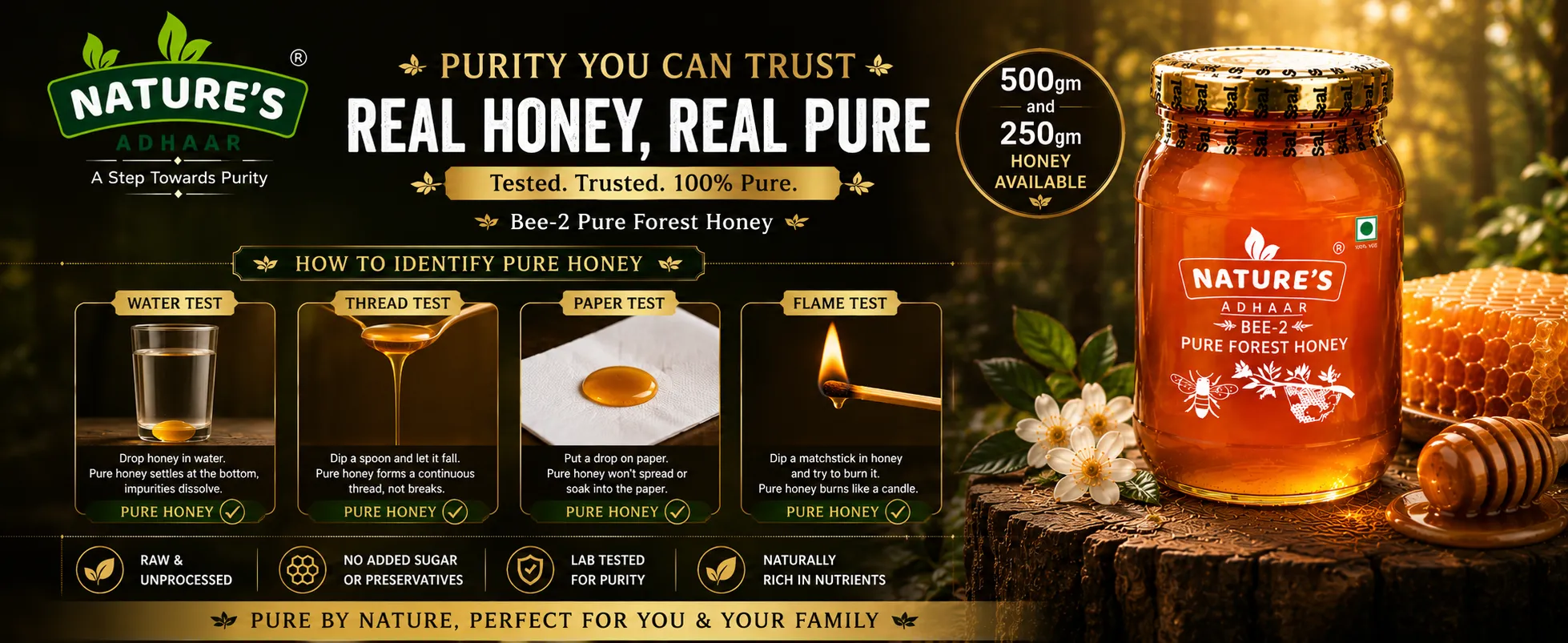
How to Identify Pure Forest Honey?
Many viral home tests claim to determine whether honey is pure by using water, tissue paper, a flame or other household methods.
These tests cannot reliably establish all aspects of honey purity or adulteration.
Instead, consider the following:
Check the Label
Read the ingredient list and product information carefully.
Check the Source
Look for transparent information about where the honey comes from.
Understand the Processing
If the product is described as raw, natural or unprocessed, check what the manufacturer means by those terms.
Check Food-Safety Information
Look for applicable food-safety and labelling information.
Check Packaging
Choose properly sealed and labelled products.
Look for Transparency
A trustworthy honey brand should provide meaningful information about its sourcing and handling.
For specific adulteration concerns, appropriate laboratory testing is more reliable than viral household purity tests.
Is Forest Honey Good for Daily Use?
Honey can be included in a balanced diet, but it should be consumed in moderation.
Although honey is naturally sourced, it still contains a significant amount of sugar.
Therefore, natural honey should not be interpreted as a food that can be consumed without considering quantity.
The appropriate amount depends on factors such as:
- Overall diet
- Age
- Activity level
- Energy requirements
- Individual dietary needs
Anyone who needs to manage sugar or carbohydrate intake should follow advice from a qualified healthcare professional or registered dietitian.
Best Ways to Use Forest Honey
Forest Honey is a versatile ingredient that can be used in many everyday foods.
Honey with Oats
Add a small amount of honey to oats along with fruits and nuts.
Honey with Yogurt
Combine plain yogurt with honey and fresh seasonal fruit.
Honey on Toast
Use honey as a naturally sweet topping for toast.
Honey in Smoothies
A small amount can be added when extra sweetness is desired.
Honey in Salad Dressing
Honey can be combined with suitable ingredients to create a sweet-and-tangy dressing.
Honey in Desserts
It can be used in selected desserts and recipes where its flavour complements other ingredients.
How Should Forest Honey Be Stored?
Proper storage helps maintain the quality of honey.
Follow these simple practices:
- Keep the jar tightly closed.
- Store it according to the manufacturer’s instructions.
- Use a clean and dry spoon.
- Avoid introducing water or moisture into the jar.
- Keep the jar away from unnecessary heat exposure.
- Do not assume crystallisation means the honey has spoiled.
Always follow the storage and best-before information provided on the product packaging.
Can Babies Eat Forest Honey?
Honey should not be given to infants below 12 months of age.
Honey can contain spores of Clostridium botulinum, which can pose a risk of infant botulism.
This precaution applies to honey generally, including Forest Honey, Raw Honey and other types of honey.
For children over 12 months, honey can be considered according to their age-appropriate diet.
Forest Honey vs Farm Honey
The key difference is generally the foraging environment available to the bees.
Forest-associated honey comes from bees that have access to natural forest vegetation and diverse floral sources.
Honey associated with agricultural areas may be influenced by cultivated crops available to bees.
However, neither description alone proves that one honey is automatically better than the other.
When choosing honey, consider:
Source + Floral Environment + Processing + Quality + Transparency
Why Choose Nature’s Adhaar Forest Honey?
At Nature’s Adhaar, our philosophy is based on connecting people with naturally sourced foods and traditional products.
Our Forest Honey is inspired by the natural diversity of forest environments and the fascinating relationship between bees and nature.
Natural Sourcing Philosophy
We focus on honey connected with natural floral environments.
Naturally Variable Character
Natural honey can vary in colour, flavour, aroma and texture depending on floral sources and season.
Quality-Focused Handling
Sourcing, hygienic handling, appropriate processing and proper packaging are important parts of maintaining product quality.
Nature-First Approach
Our philosophy is simple:
Nature provides the diversity. We focus on bringing it to you with care.
Frequently Asked Questions About Forest Honey
What is Forest Honey?
Forest Honey is honey produced by bees that forage among flowering plants and vegetation found in or around forest environments.
Is Forest Honey pure?
The term “Forest Honey” describes its sourcing environment and does not by itself prove purity. Check the ingredients, sourcing, processing and quality information.
Is Forest Honey the same as Raw Honey?
No. Forest Honey generally describes the bees’ foraging environment, while Raw Honey refers to how honey is handled or processed after extraction.
Why does Forest Honey crystallize?
Crystallisation is a natural process influenced by the honey’s sugar composition, floral source, temperature and storage conditions.
Does crystallised honey mean it is pure?
Not necessarily. Pure honey can crystallize, but crystallisation alone cannot prove purity.
Can Forest Honey be consumed every day?
Honey can be included in a balanced diet, but it contains sugars and should be consumed in moderation.
How should Forest Honey be stored?
Keep it tightly closed, use a clean and dry spoon, avoid moisture and follow the storage instructions on the product packaging.
Final Thoughts
Forest Honey is a naturally sourced honey associated with bees foraging among diverse vegetation and flowering plants in forest environments.
Its colour, flavour, aroma and texture can naturally vary depending on the floral sources, season and geographical location.
When choosing Forest Honey, don’t rely only on words such as “pure,” “natural,” “raw” or “forest.” Look at the complete picture—including sourcing, ingredients, processing, packaging, quality information and brand transparency.
At Nature’s Adhaar, our philosophy is to stay connected with nature and bring naturally inspired products from their source to your table.
Leave a Reply