How to Identify Pure Honey: Common Myths and Facts
Honey has been valued for generations for its natural sweetness, distinctive flavour and connection with nature. But when buying honey, one common question comes to mind: How can you identify pure honey?
With so many products available in the market, understanding the source, ingredients, processing and labelling can help you make a more informed choice.
At Nature’s Adhaar, we believe that choosing good honey starts with understanding what is actually inside the jar and where it comes from.
What Does Pure Honey Mean?
Pure honey generally refers to honey that is not mixed with other sweeteners or unnecessary ingredients.
However, appearance alone cannot prove honey purity. Colour, thickness, aroma and crystallisation can naturally vary depending on the floral source, season and storage conditions.
This is why consumers should look beyond simple home tests and pay attention to reliable product information.
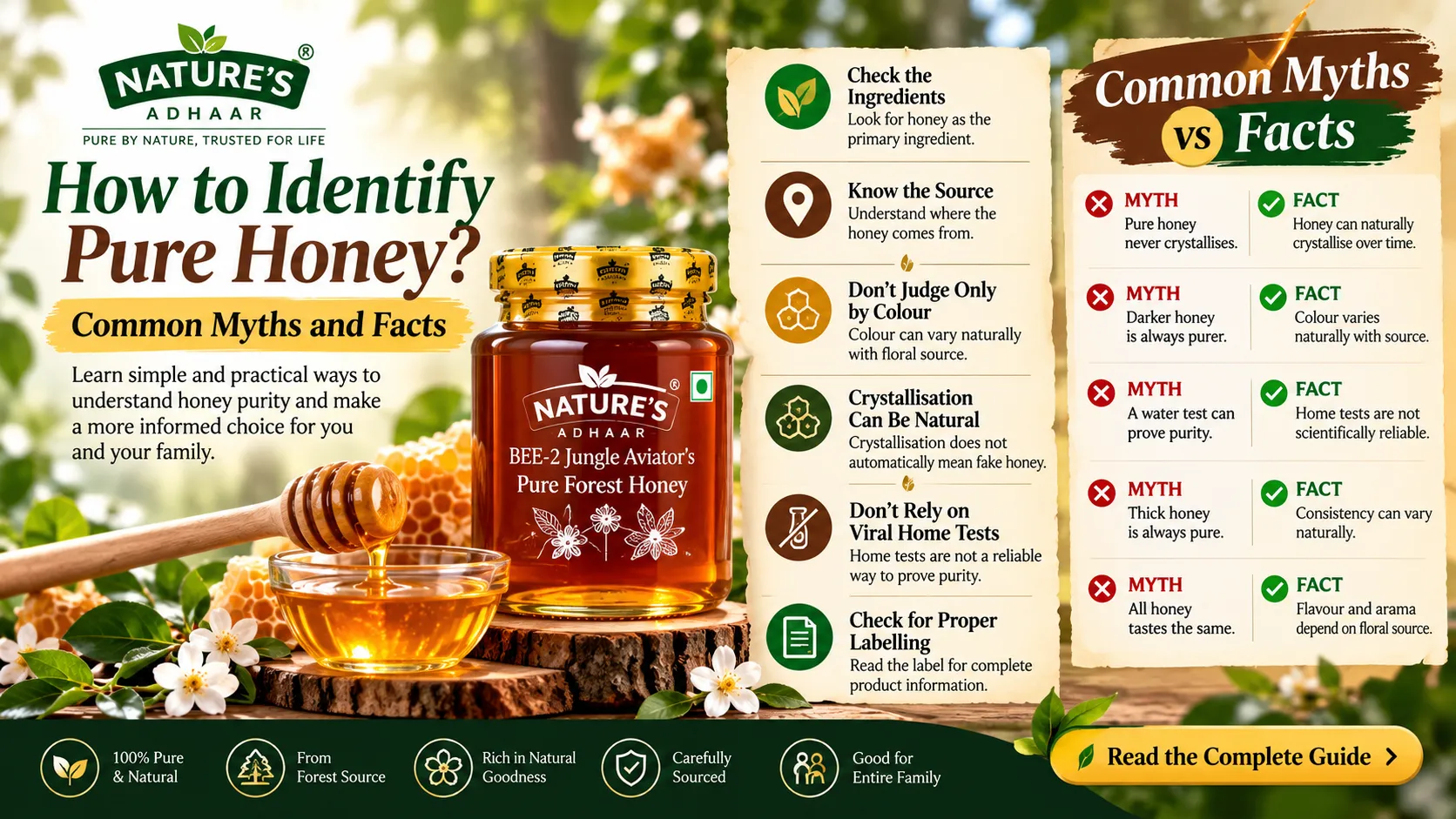
1. Check the Ingredients
One of the first things to check on a honey jar is the ingredient list.
Look for a product where honey is clearly identified as the primary or only ingredient, depending on the product formulation.
Avoid making a purchase based only on attractive packaging or marketing claims. Always read the label carefully.
2. Understand Where the Honey Comes From
The source of honey can tell you a lot about its character.
Honey collected from different floral and geographical sources can have different:
- Colours
- Flavours
- Aromas
- Textures
- Natural characteristics
Forest honey, for example, may have a distinctive taste and aroma because bees collect nectar from diverse wild flora.
Nature’s Adhaar Pure Forest Honey is positioned around its natural forest source and is presented as raw, unfiltered and unprocessed.
3. Don’t Judge Honey Only by Its Colour
A common misconception is:
“Darker honey is always purer.”
This is not necessarily true.
Honey can naturally range from light golden to darker shades depending on its botanical source and other natural factors.
Therefore, colour alone should not be used as a purity test.
4. What About Honey Crystallisation?
Another common myth is:
“If honey crystallises, it must be fake.”
Actually, crystallisation can be a natural process.
Different types of honey crystallise at different rates depending on their natural composition, temperature and floral source.
So crystallisation by itself does not automatically mean that honey is impure.
5. Don’t Depend on Viral Home Tests
You may have seen online tests such as:
- Water test
- Flame test
- Thumb test
- Bread test
These tests are often shared as simple ways to identify pure honey.
However, these home tests are not reliable scientific methods for establishing honey purity.
For a more informed purchase, look at the product’s ingredient information, source, processing details, labelling and applicable quality information.
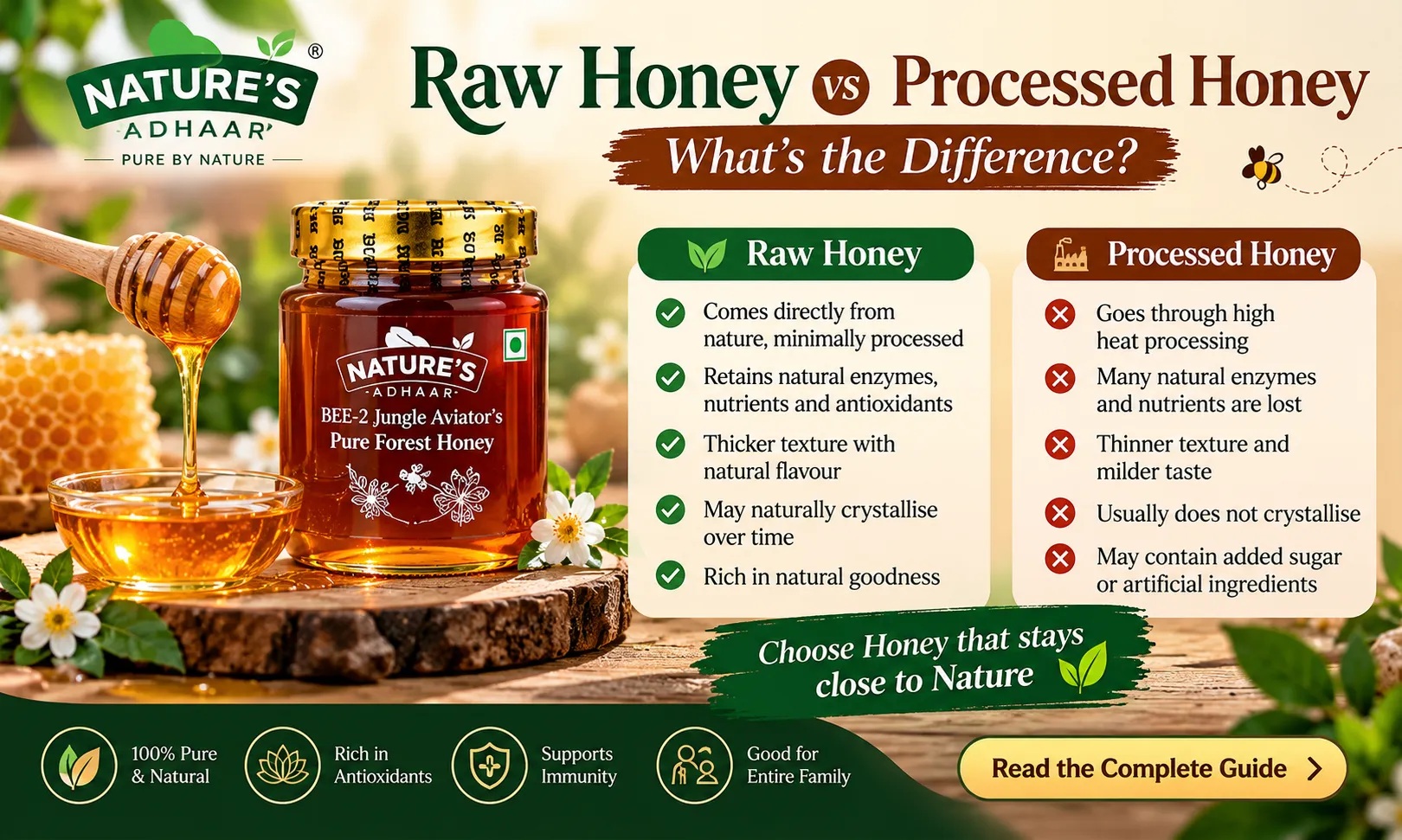
6. Check the Processing Information
The way honey is handled after collection can affect its characteristics.
Some honey products are heated or processed, while others are marketed as raw or minimally processed.
If you specifically want raw honey, check whether the product clearly states its processing information rather than assuming that all honey is processed in the same way.
7. Look for Proper Labelling
Before buying honey, check the product label for important information such as:
- Product name
- Net quantity
- Ingredients
- Manufacturer/marketer details
- FSSAI licence information
- Batch information
- Best-before/use-by information
- Customer care details
Clear and complete labelling makes it easier for consumers to understand what they are purchasing.
Common Honey Myths vs Facts
Myth 1: Pure honey never crystallises.
Fact: Honey can naturally crystallise over time.
Myth 2: Dark honey is always better or purer.
Fact: Honey colour varies naturally according to its source.
Myth 3: A water test can prove honey purity.
Fact: Simple home tests cannot reliably establish honey purity.
Myth 4: Thick honey is always pure.
Fact: Honey’s consistency can vary naturally with temperature, composition and source.
Myth 5: All honey tastes the same.
Fact: Floral and geographical sources can influence honey’s flavour and aroma.
How to Choose Honey More Carefully
Before purchasing honey, consider these simple points:
1. Read the label
Understand the ingredients and product information.
2. Check the source
Look for clear information about where the honey comes from.
3. Understand the processing
If you prefer raw or minimally processed honey, check the product description carefully.
4. Don’t rely on viral tests
Home tests are not a dependable way to prove purity.
5. Buy from a transparent brand
Choose brands that clearly communicate their product information and sourcing.
Why Source Matters at Nature’s Adhaar
At Nature’s Adhaar, our Pure Forest Honey is presented as a product sourced from forest environments and is labelled Raw, Unfiltered and Unprocessed.
Our approach focuses on keeping the story of the honey connected to its natural source—from the forest to the jar.
We believe consumers deserve clear information so they can make their own informed choices.
Final Thoughts
Identifying pure honey isn’t simply about performing a viral home test or judging a jar by its colour or thickness.
A better approach is to look at the source, ingredients, processing information, labelling and overall product transparency.
The next time you buy honey, take a moment to read the label and understand what you’re purchasing.
Because knowing your honey is the first step towards choosing it wisely. 🍯🌿
Explore Nature’s Adhaar Pure Forest Honey
Raw • Unfiltered • Unprocessed
Visit: naturesadhaar.in
FAQ
Is crystallised honey pure?
Crystallisation can be a natural characteristic of honey and does not by itself prove that honey is fake or impure.
Can a water test prove honey purity?
No. Simple home tests such as the water test are not reliable scientific methods for determining honey purity.
Does the colour of honey indicate its purity?
No. Honey can naturally have different colours depending on its floral and geographical source.
What should I check before buying honey?
Check the ingredients, source, processing information, product labelling and manufacturer details.
What is raw honey?
Raw honey is generally described as honey that has undergone minimal processing. Always check the specific product’s label and description to understand how it has been handled.
Leave a Reply