

Ghee has been an important part of Indian kitchens for generations. From adding a spoonful to hot dal and khichdi to preparing traditional sweets and festive dishes, ghee is deeply connected with Indian food culture.
But today, consumers come across many different terms while buying ghee—A2 Ghee, Gir Cow Ghee, Bilona Ghee, Desi Ghee and A2 Gir Cow Bilona Ghee.
So, what is A2 Gir Cow Bilona Ghee, and what makes it different?
In this complete guide, we explain its meaning, traditional Bilona preparation process, culinary benefits, everyday uses, storage and what you should check before choosing good-quality ghee.
What is A2 Gir Cow Bilona Ghee?
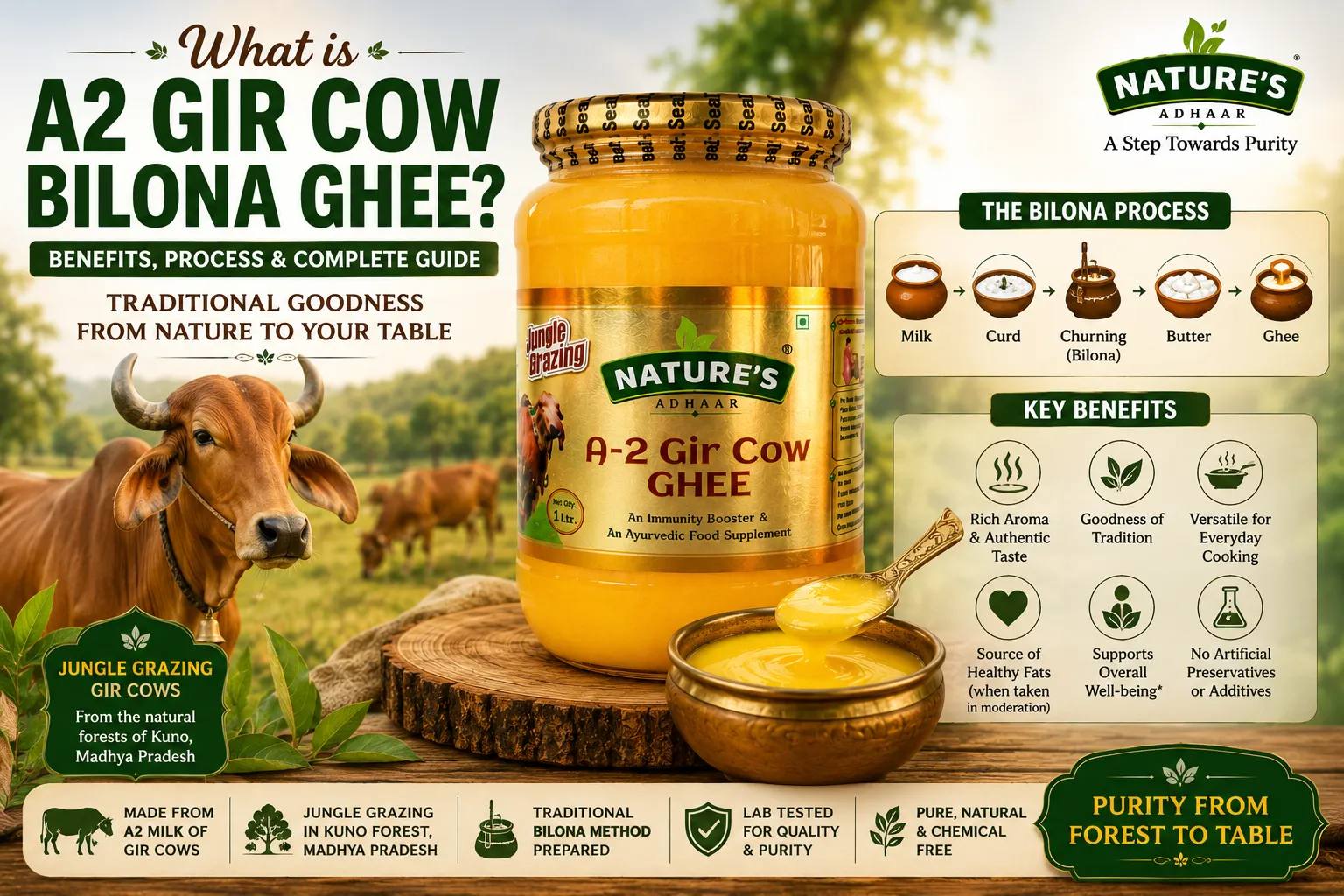
A2 Gir Cow Bilona Ghee is ghee prepared from milk sourced from indigenous Gir cows using a traditional curd-churning process commonly known as the Bilona Method.
The name can be understood in three parts:
A2 – refers to A2 beta-casein associated with the milk used as the starting ingredient.
Gir Cow – refers to the indigenous Indian Gir cattle breed from which the milk is sourced.
Bilona Ghee – refers to ghee prepared through the traditional process in which milk is converted into curd, the curd is churned to obtain butter, and the butter is then heated to prepare ghee.
In simple terms:
Gir Cow Milk → Curd → Traditional Churning → Butter → Ghee
It is this combination of source and traditional preparation that gives A2 Gir Cow Bilona Ghee its distinct identity.
What Does “A2” Mean?
A2 refers to a type of beta-casein protein found in milk.
Certain cattle produce milk containing the A2 form of beta-casein.
However, there is an important distinction consumers should understand: ghee is predominantly milk fat, and most milk proteins are removed during the clarification process.
Therefore, when buying premium ghee, the word “A2” should not be the only consideration.
You should also look at:
- Source of milk
- Cow breed
- Grazing and feeding practices
- Ghee preparation method
- Ingredients
- Quality control
- Packaging
- Brand transparency
What is Special About Gir Cows?
The Gir cow is one of India’s well-known indigenous cattle breeds.
Gir cows are easily recognised by characteristics such as their distinctive curved horns, long ears and prominent forehead.
For traditional ghee production, the quality and origin of milk are important considerations.
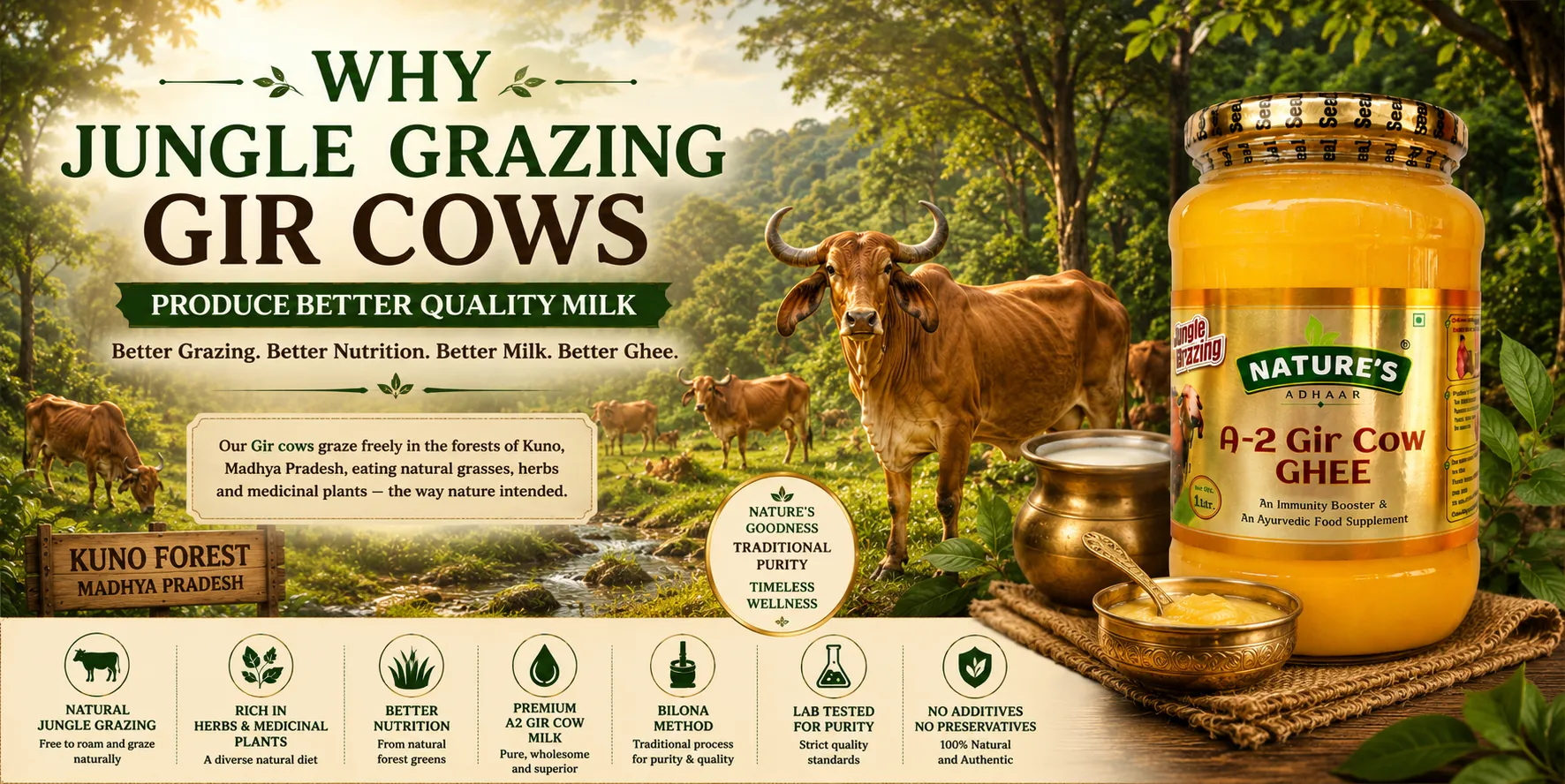
At Nature’s Adhaar, our philosophy goes one step further by focusing on Jungle Grazing Gir cows associated with the natural surroundings of Kuno, Madhya Pradesh.
What is Jungle Grazing Gir Cow Ghee?
The quality story of ghee begins long before the milk reaches the kitchen.
Nature’s Adhaar’s Jungle Grazing philosophy focuses on Gir cows grazing in natural surroundings, with access to naturally available vegetation.
Rather than viewing ghee only as a finished product, we believe its complete journey matters:
Nature → Gir Cow → Milk → Curd → Bilona → Butter → Ghee
This forest-to-table philosophy forms an important part of the Nature’s Adhaar identity.
What is the Traditional Bilona Method?
The Bilona Method is a traditional Indian method of preparing ghee.
Instead of simply treating ghee as a processed milk-fat product, this method involves multiple stages.
Step 1: Milk Collection
The process begins with milk sourced from Gir cows.
The quality and handling of milk at this stage are important because milk is the foundation of the final product.
Step 2: Preparing Curd
The milk is used to prepare curd.
This is an important distinction between the traditional Bilona method and processes where ghee may be manufactured directly from cream.
Step 3: Churning the Curd
The prepared curd is churned.
Traditionally, this churning process is known as Bilona.
Churning separates butter from the liquid portion of the curd.
Step 4: Butter Separation
The butter obtained after churning is carefully collected.
This butter becomes the base material for preparing ghee.
Step 5: Preparing Ghee
The butter is then heated carefully.
During this process, moisture is removed and the milk solids separate, leaving behind the characteristic golden ghee.
Step 6: Filtering & Packing
The prepared ghee is filtered and packed under suitable hygienic conditions.
The complete traditional journey therefore becomes:
Milk → Curd → Churning → Butter → Heating → Ghee
What Are the Benefits of A2 Gir Cow Bilona Ghee?
When discussing ghee, it is important not to make exaggerated medical claims. Ghee is a food and a concentrated source of dietary fat.
Its practical benefits are better understood in terms of traditional preparation, culinary versatility, taste and its role within a balanced diet.
1. Rich Traditional Taste & Aroma
One of the biggest reasons people choose traditionally prepared ghee is its distinctive aroma.
A small amount can enhance the flavour of:
- Dal
- Khichdi
- Rice
- Roti
- Paratha
- Vegetables
- Traditional sweets
The aroma becomes particularly noticeable when ghee is used for tadka.
2. Versatile Cooking Fat
A2 Gir Cow Bilona Ghee can be used in a wide variety of Indian recipes.
It is suitable for:
Tadka | Sautéing | Roasting | Parathas | Traditional Sweets | Selected Frying Applications
This versatility makes ghee useful across breakfast, lunch and dinner recipes.
3. Suitable for Traditional Indian Cooking
Indian cuisine has historically used ghee in numerous preparations.
It pairs naturally with spices such as:
- Jeera
- Hing
- Turmeric
- Garlic
- Curry leaves
- Mustard seeds
- Red chilli
A traditional ghee tadka can bring aroma and richness to an otherwise simple meal.
4. Naturally Rich and Satisfying Flavour
Because ghee has a concentrated flavour, a relatively small quantity can noticeably change the taste and mouthfeel of food.
This is why ghee is often added as a finishing ingredient over hot rotis, dal, rice or khichdi.
5. Part of India’s Traditional Food Culture
Bilona Ghee is closely associated with India’s traditional dairy practices.
The curd-to-butter-to-ghee process reflects a method that has been followed in Indian households and communities for generations.
Choosing traditionally prepared ghee can therefore also be about preserving and appreciating India’s culinary heritage.
Is A2 Gir Cow Bilona Ghee Good for Daily Use?
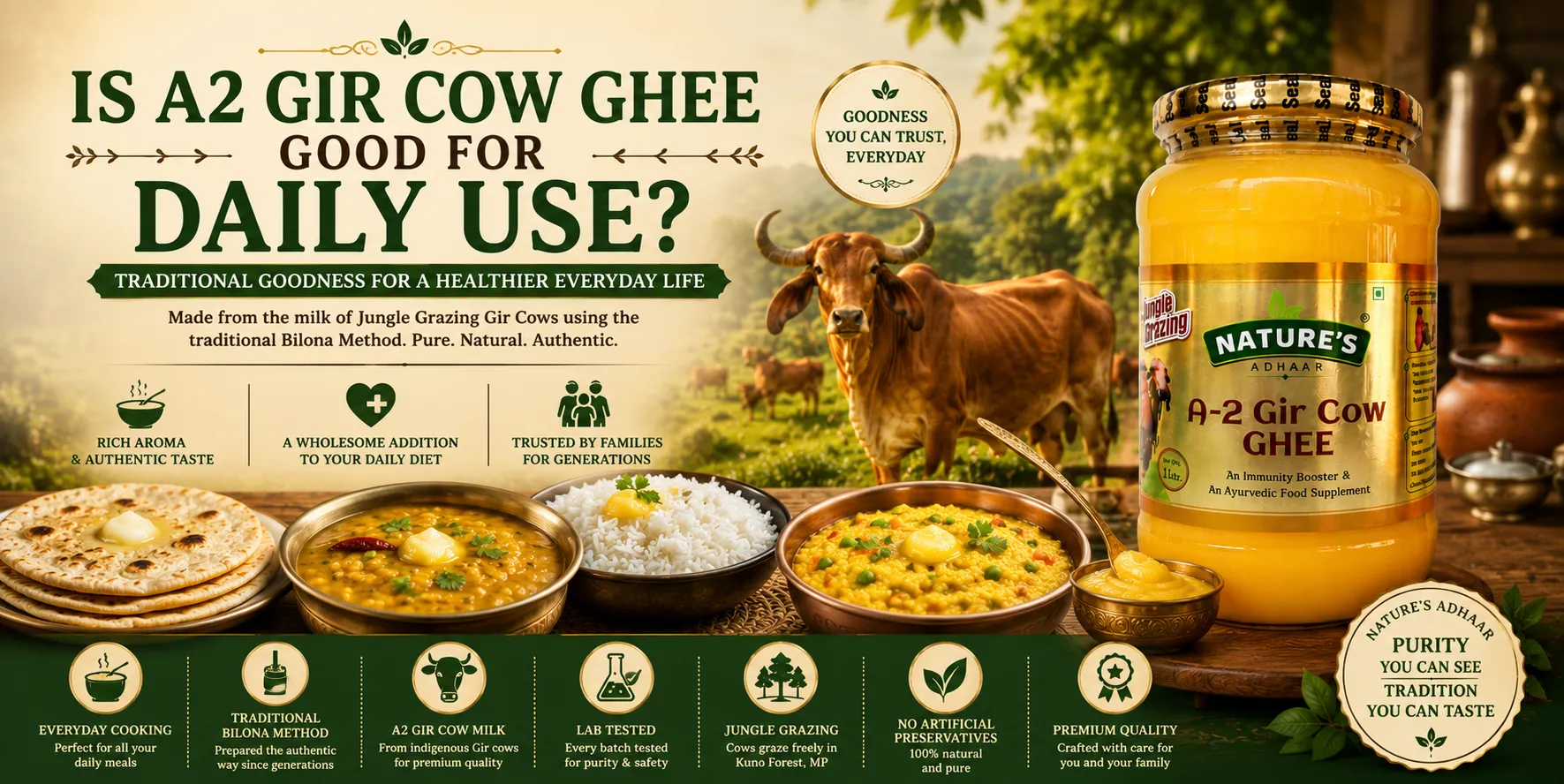
Ghee can be included in everyday meals as part of a balanced and varied diet.
However, quantity matters.
Ghee is a concentrated source of fat and calories. The appropriate amount varies depending on:
- Overall diet
- Age
- Physical activity
- Energy requirements
- Other dietary fat sources
- Individual health requirements
Therefore, there is no single quantity that is appropriate for everyone.
People who have specific medical conditions or have been advised to restrict dietary fats should follow the recommendations of their healthcare professional or registered dietitian.
How Can You Use A2 Gir Cow Bilona Ghee?
One of the advantages of ghee is that it is extremely easy to incorporate into Indian cooking.
With Roti
Apply a suitable amount over freshly prepared hot rotis.
With Dal
Prepare an aromatic ghee tadka with jeera, hing, garlic or other spices.
With Khichdi
A little ghee over freshly prepared khichdi can add characteristic aroma and richness.
With Rice
Ghee can be combined with hot rice according to the dish and personal preference.
For Parathas
Use ghee while preparing or finishing parathas.
For Roasting
Use it for roasting makhana, nuts, suji, besan or selected spices.
For Traditional Sweets
Ghee is an important ingredient in preparations such as:
- Besan ladoo
- Atta halwa
- Moong dal halwa
- Panjiri
- Pinni
- Various festive sweets
A2 Gir Cow Bilona Ghee vs Regular Ghee
Although both products are ghee, their sourcing and manufacturing processes can differ.
| Feature | A2 Gir Cow Bilona Ghee | Regular Ghee |
|---|---|---|
| Milk Source | Gir cow milk | May vary |
| Preparation | Traditional curd-churning Bilona process | Process may vary |
| Curd Stage | Yes, in traditional Bilona preparation | Not necessarily |
| Churning | Traditional Bilona step | May not be used |
| Taste & Aroma | Characteristic traditional profile | Varies by product |
| Production Process | Multi-stage | Depends on manufacturer |
| Price | Often premium | Varies widely |
The key difference is therefore not simply the name on the jar—it is the source and process behind the product.
Bilona Ghee vs Desi Ghee – Are They the Same?
Not always.
Desi Ghee is a broad term commonly used for traditional Indian ghee.
Bilona Ghee, however, specifically refers to a method involving curd and churning.
So when a product claims to be Bilona Ghee, check whether the manufacturer clearly explains the process.
Look for:
Milk → Curd → Churning → Butter → Ghee
This provides a clearer understanding than relying only on marketing terminology.
How to Identify Good-Quality A2 Gir Cow Bilona Ghee
Consumers often search for home tests to check ghee purity. However, simple home tests cannot conclusively establish every aspect of purity or authenticity.
A better approach is to evaluate several factors.
Check the Ingredient Label
Read the packaging carefully and understand what the product contains.
Check the Milk Source
A transparent brand should provide information about where its milk comes from.
Check the Preparation Method
If the product is marketed as Bilona Ghee, look for information explaining the actual Bilona process.
Check Packaging
Purchase properly sealed ghee and inspect the packaging before use.
Check Quality Information
Look for relevant quality and food-safety information provided by the manufacturer.
Check Brand Transparency
The brand should clearly communicate its sourcing, preparation and quality philosophy.
Does the Colour of Ghee Prove Its Purity?
No.
Colour alone cannot prove whether ghee is pure.
Natural variations can occur because of:
- Milk source
- Animal diet
- Season
- Preparation process
- Storage temperature
Ghee may range from lighter yellow to deeper golden shades.
Therefore, avoid assuming that darker yellow automatically means better or purer ghee.
Why Does Ghee Become Grainy or Liquid?
The texture of ghee can naturally change according to temperature and the crystallisation of milk fats.
During warmer weather, ghee may become:
Soft → Semi-liquid → Liquid
During cooler weather, it may become:
Semi-solid → Grainy → Solid
These physical changes can occur naturally.
A grainy texture alone should not be treated as conclusive proof of purity.
How Should A2 Gir Cow Bilona Ghee Be Stored?
Proper storage helps maintain product quality.
Follow these simple practices:
- Keep the container properly closed.
- Store according to the instructions printed on the packaging.
- Use a clean and completely dry spoon.
- Avoid introducing water into the jar.
- Keep the product away from unnecessary moisture.
- Avoid contaminating the jar with food particles.
Always follow the manufacturer’s storage and best-before instructions.
Why Is Traditional Bilona Ghee More Expensive?
Consumers often wonder why authentic Bilona Ghee can cost more than conventional ghee.
The answer lies partly in the process.
Traditional Bilona preparation involves several stages:
Milk → Curd → Churning → Butter → Ghee
The final price can also reflect:
- Milk sourcing
- Production scale
- Labour
- Traditional processing
- Quality testing
- Packaging
- Logistics
Therefore, while comparing prices, don’t compare only price per litre.
Compare the complete source-to-jar journey.
Why Choose Nature’s Adhaar A2 Gir Cow Bilona Ghee?
At Nature’s Adhaar, we believe premium ghee should have a story that begins at its source.
Our approach focuses on:
Jungle Grazing Gir Cows
Our sourcing philosophy is associated with Gir cows grazing in the natural surroundings of Kuno, Madhya Pradesh.
Traditional Bilona Method
We focus on the traditional:
Milk → Curd → Churning → Butter → Ghee
process.
No Artificial Preservatives
Our focus is on keeping the product close to its traditional character without artificial preservatives.
Quality Focus
Careful handling, processing and applicable quality checks form part of our approach.
Traditional Aroma & Taste
The objective is to provide the distinctive flavour and aroma consumers associate with traditionally prepared ghee.
For Nature’s Adhaar, ghee isn’t simply about what is inside the jar.
It is about the complete journey:
From Jungle Grazing Gir Cows to Traditional Bilona Ghee — Purity from Forest to Table.
Frequently Asked Questions About A2 Gir Cow Bilona Ghee
Is A2 Gir Cow Ghee the same as Bilona Ghee?
Not necessarily. “A2 Gir Cow” describes the milk source, whereas “Bilona” describes the traditional preparation method. A product described as A2 Gir Cow Bilona Ghee combines both concepts.
Can A2 Gir Cow Bilona Ghee be used for cooking?
Yes. Ghee can be used for tadka, sautéing, roasting, parathas, traditional sweets and various other Indian recipes.
Can I eat A2 Gir Cow Ghee daily?
Ghee can be included in a balanced diet, but the appropriate quantity depends on your overall diet and individual nutritional requirements.
Does pure ghee need refrigeration?
Follow the storage instructions provided by the manufacturer. Keep the container properly closed and always use a clean, dry spoon.
Is yellow colour proof of pure Gir Cow Ghee?
No. Colour alone cannot establish purity or authenticity.
Is grainy ghee pure?
Graininess can naturally develop due to fat crystallisation, but texture alone cannot conclusively prove purity.
What makes Bilona Ghee different?
The defining feature is its traditional curd-churning preparation: milk is converted into curd, churned to obtain butter and then the butter is heated to prepare ghee.
Final Thoughts
A2 Gir Cow Bilona Ghee brings together an indigenous milk source and a traditional Indian ghee-making process.
But when choosing premium ghee, don’t focus only on words such as “A2,” “pure” or “premium.”
Look deeper into:
Where does the milk come from?
Which cows provide it?
How is the ghee prepared?
Is the brand transparent about its process?
How is quality maintained?
At Nature’s Adhaar, our philosophy combines Jungle Grazing Gir cows from the natural surroundings of Kuno with traditional Bilona preparation to bring India’s traditional ghee-making heritage to today’s kitchen.
From dal and khichdi to rotis, parathas and traditional sweets, ghee continues to hold a special place in Indian food culture.
Nature’s Adhaar — Purity from Forest to Table.
For product details and availability, visit Nature’s Adhaar.
Leave a Reply