

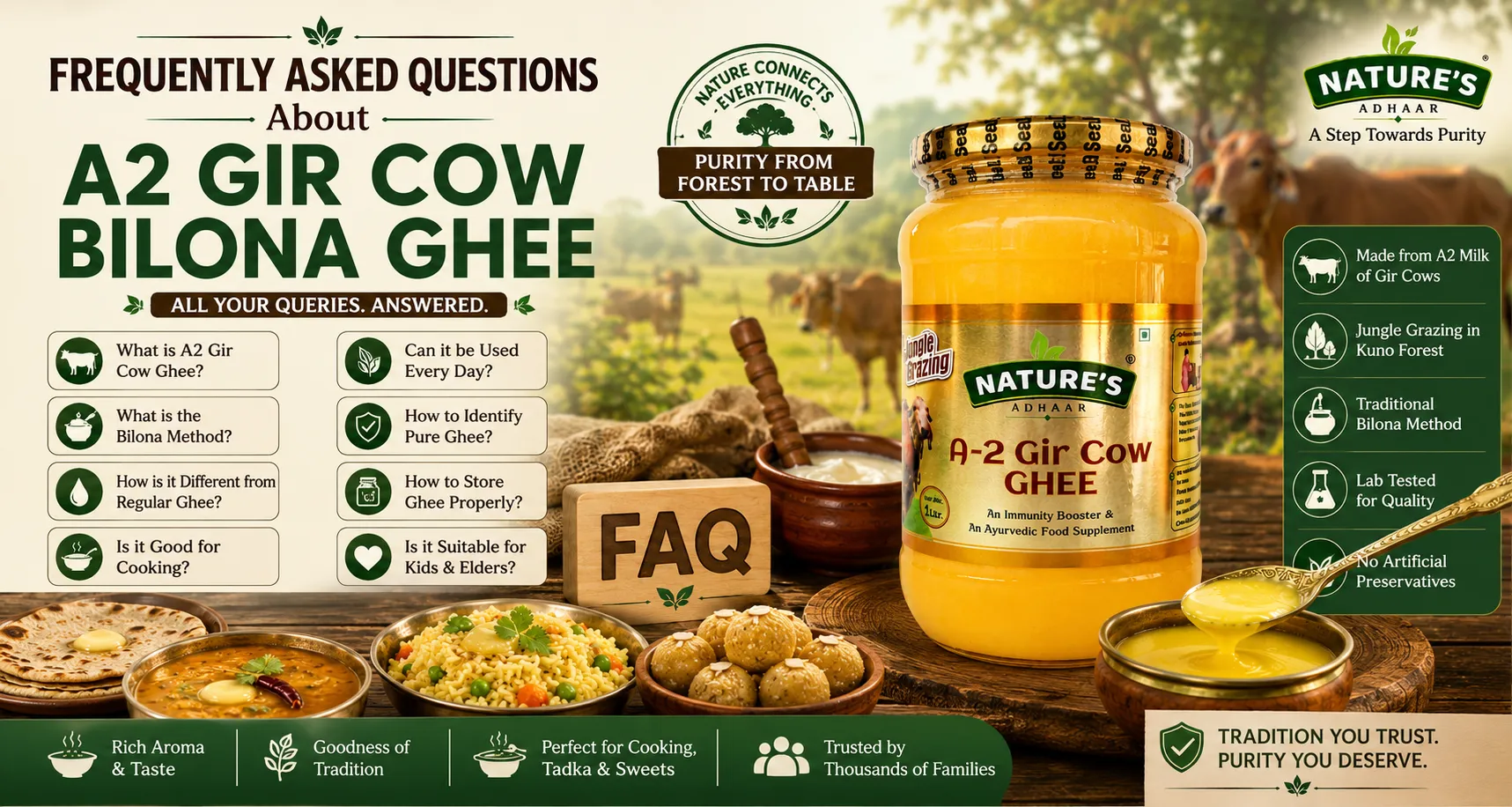
FAQs– A2 Gir Cow Bilona Ghee has become increasingly popular among people looking for traditionally prepared Indian foods. But with growing interest come many questions.
What exactly is A2 Gir Cow Ghee? What does Bilona mean? How is it different from regular ghee? Can you use it every day? Is it suitable for cooking? And how can you identify good-quality ghee?
In this guide, we answer some of the most frequently asked questions about A2 Gir Cow Bilona Ghee to help you understand its source, preparation, uses and quality.
1. What Is A2 Gir Cow Ghee?
A2 Gir Cow Ghee is ghee prepared from milk sourced from Gir cows, an indigenous Indian cattle breed.
The term A2 refers to a type of beta-casein protein associated with the milk used as the starting ingredient. However, ghee itself is primarily milk fat, and after clarification it contains very little milk protein.
When choosing ghee, therefore, it is useful to look beyond the term A2 and also consider the source of milk, preparation method, quality standards and transparency of the brand.
2. What Is A2 Gir Cow Bilona Ghee?
A2 Gir Cow Bilona Ghee combines two important elements:
Gir Cow Milk + Traditional Bilona Preparation
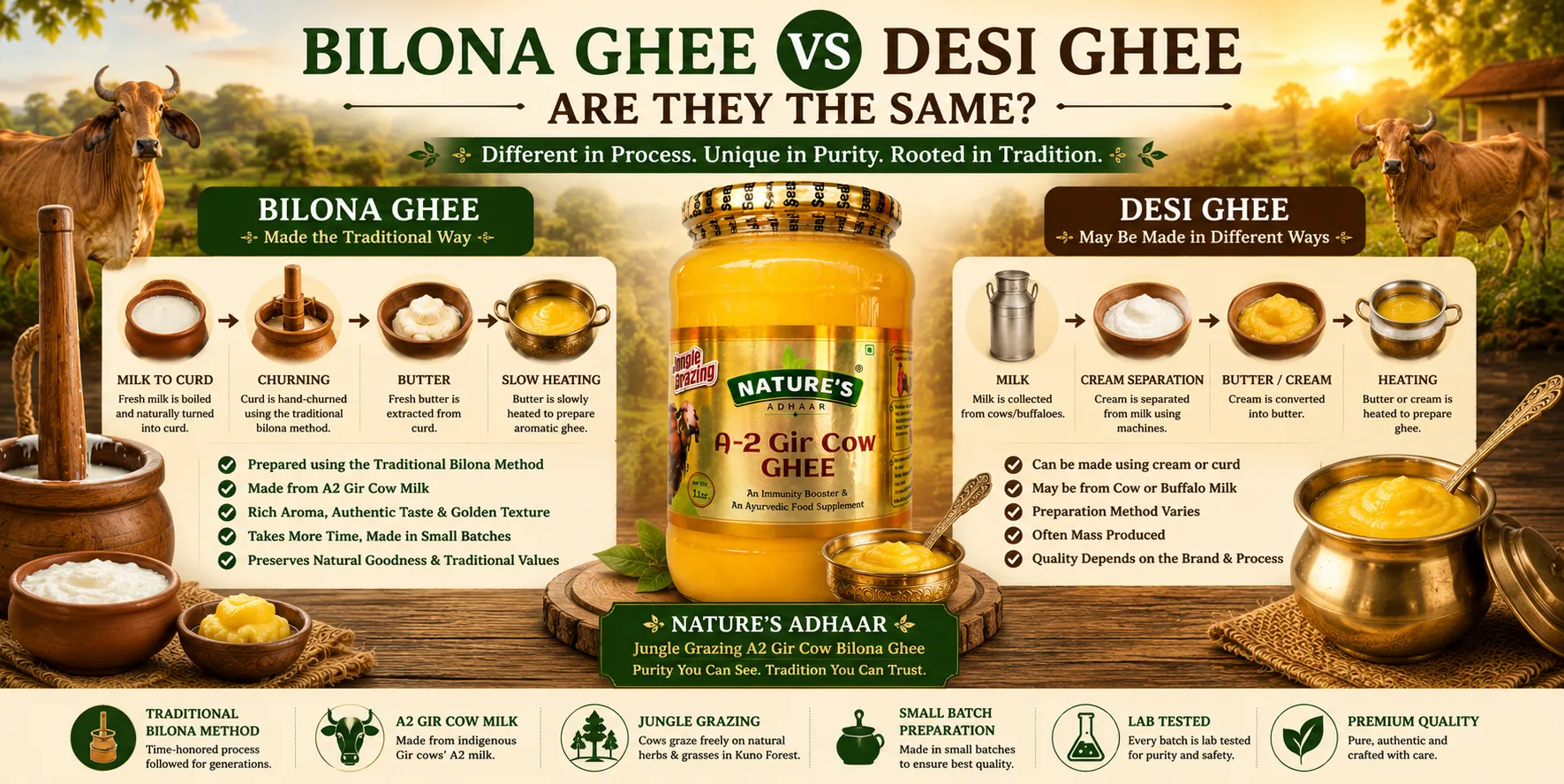
The traditional Bilona method generally follows this journey:
Milk → Curd → Churning → Butter → Ghee
Milk is converted into curd, the curd is churned to separate butter, and the butter is then carefully heated to prepare ghee.
This traditional process gives Bilona Ghee its characteristic aroma, texture and flavour.
3. What Does “Bilona” Mean?
Bilona refers to the traditional churning process used in Indian dairy preparation.
Traditionally, curd is churned to separate butter. The butter is subsequently heated to remove moisture and milk solids, producing ghee.
This differs from manufacturing processes that prepare ghee directly from cream or other dairy fat streams.
For consumers looking for traditionally prepared ghee, understanding the production method can therefore be important.
4. What Is Special About Gir Cows?
Gir is one of India’s indigenous cattle breeds.
Nature’s Adhaar places particular emphasis on Gir cows and their natural grazing environment as part of its sourcing philosophy.
Rather than looking only at the finished jar of ghee, we believe the journey should begin with understanding the animal, its environment and the source of the milk.
5. What Is Jungle Grazing Gir Cow Ghee?
Jungle Grazing is an important part of the Nature’s Adhaar philosophy.
Our Gir cows are associated with the natural surroundings of Kuno, Madhya Pradesh, where grazing takes place in a natural environment with access to naturally available vegetation.
Nature’s Adhaar connects this sourcing approach with traditional Bilona preparation to create its Jungle Grazing A2 Gir Cow Bilona Ghee.
For us, the journey is:
Nature → Gir Cows → Milk → Traditional Bilona Process → Ghee → Your Table
6. Is A2 Gir Cow Ghee the Same as Regular Ghee?

Not necessarily.
The term ghee describes the finished clarified milk-fat product, while terms such as A2 Gir Cow and Bilona provide additional information about the source and/or preparation method.
Products may differ in:
- Breed and source of cows
- Milk sourcing
- Feeding and grazing practices
- Manufacturing process
- Quality control
- Flavour and aroma
- Packaging and storage
Therefore, two jars labelled “ghee” can have very different sourcing and production stories.
7. Is Bilona Ghee Different from Desi Ghee?
The terms are sometimes used interchangeably in marketing, but they do not necessarily describe exactly the same thing.
Desi Ghee is a broad term commonly used for traditional-style ghee.
Bilona Ghee specifically refers to ghee prepared using a curd-churning-based traditional process.
When purchasing a product, check the label and the manufacturer’s explanation of its actual preparation process rather than relying only on terminology.
8. What Does A2 Mean in A2 Ghee?
A2 refers to A2 beta-casein, a type of milk protein.
Certain cattle produce milk associated with A2 beta-casein.
However, an important distinction is often overlooked: ghee is predominantly milk fat, and most milk proteins are removed during clarification.
Therefore, consumers should avoid assuming that all claims associated with A2 milk automatically apply to ghee.
9. What Does A2 Gir Cow Bilona Ghee Taste Like?
Taste varies according to milk quality and preparation.
Traditionally prepared Bilona Ghee generally has a rich, distinctive dairy aroma and characteristic ghee flavour.
It works particularly well in Indian foods where the aroma of ghee contributes to the overall eating experience.
Examples include:
- Dal tadka
- Khichdi
- Hot rotis
- Parathas
- Rice
- Halwa
- Ladoo
- Panjiri
10. What Colour Should Pure Gir Cow Ghee Be?
Colour alone cannot reliably determine purity.
Ghee may naturally vary from pale yellow to deeper golden shades depending on factors such as the source of milk, diet of the animal and preparation process.
Therefore, avoid judging purity only by colour.
A trustworthy label, appropriate testing, transparent sourcing and manufacturing information are more meaningful indicators.
11. How Can I Identify Pure A2 Gir Cow Ghee?
There is no single home test that can conclusively establish every aspect of ghee purity.
Instead, check multiple factors:
Ingredient Label: Read the product information carefully.
Source: Look for transparency regarding the source of milk.
Preparation Method: Understand whether the product is actually prepared through the Bilona process if it is marketed as Bilona Ghee.
Quality Testing: Look for appropriate quality-testing information.
Packaging: Buy properly sealed products.
Brand Transparency: Prefer brands that clearly explain their sourcing and manufacturing practices.
Laboratory testing is more reliable than viral “home purity tests” for determining adulteration.
12. Can A2 Gir Cow Ghee Be Used Every Day?
Ghee can be included in everyday meals as part of an overall balanced diet.
However, ghee is a concentrated source of fat and calories, so the amount consumed matters.
Individual requirements differ depending on age, activity level, overall diet and health status.
People with specific medical or dietary restrictions should follow advice from an appropriate healthcare professional or registered dietitian.
13. Is A2 Gir Cow Ghee Good for Cooking?
Ghee is widely used in Indian cooking and can be used for:
- Tadka
- Sautéing
- Roasting
- Parathas
- Dal
- Khichdi
- Traditional sweets
- Selected frying applications
Its distinctive aroma makes it especially suitable for recipes where the flavour of the cooking fat is an important part of the dish.
14. Can A2 Gir Cow Ghee Be Used for High-Heat Cooking?
Ghee can be used for relatively high-temperature cooking.
During ghee preparation, much of the water and milk solids found in butter are removed, changing its cooking characteristics.
However, like other cooking fats, ghee should not be unnecessarily overheated.
If it begins smoking excessively or develops a burnt smell, reduce the cooking temperature.
15. Can I Use A2 Gir Cow Ghee on Roti and Paratha?
Yes.
One of the simplest ways to enjoy ghee is to apply a suitable amount over a freshly prepared hot roti or paratha.
You can also use ghee during the preparation of parathas according to your recipe.
16. Can A2 Gir Cow Ghee Be Added to Dal or Khichdi?
Yes.
A small quantity of ghee can be added to freshly prepared dal or khichdi for flavour and aroma.
You can also prepare a traditional tadka using ghee, jeera, hing, garlic, chilli or other spices depending on the recipe.
17. Can A2 Gir Cow Ghee Be Used for Making Sweets?
Yes. Ghee is traditionally used in many Indian sweets.
Popular examples include:
- Besan ladoo
- Atta halwa
- Moong dal halwa
- Panjiri
- Pinni
- Other festive preparations
The aroma and texture of ghee can play an important role in the final character of these recipes.
18. Does Pure Ghee Need Refrigeration?
Ghee generally has relatively low moisture when properly prepared and can often be stored at room temperature according to the manufacturer’s storage instructions.
Always keep the jar properly closed and use a clean, dry spoon.
Avoid introducing water or moisture into the container, as this can affect product quality.
Always follow the storage instructions printed on the product packaging.
19. Why Does Ghee Become Grainy?
A grainy or granular texture can occur naturally in ghee due to the way different milk fats crystallize during cooling and storage.
Texture may change with temperature.
Therefore, graininess by itself should not automatically be interpreted as proof of purity or impurity.
20. Why Does Ghee Become Liquid in Summer?
Ghee responds naturally to temperature.
In warmer weather, it may become softer or completely liquid. At cooler temperatures, it may become semi-solid or solid.
These changes in physical state can occur naturally and do not by themselves indicate a problem with the product.
21. Why Is Bilona Ghee Often More Expensive?
Traditional Bilona Ghee can involve a more elaborate production process than some conventional manufacturing methods.
The process involves:
Milk → Curd → Churning → Butter → Ghee
Factors such as milk sourcing, production scale, labour, quality standards, packaging and testing can also influence the final price.
Therefore, when comparing ghee prices, it is useful to compare the source and process, not simply the price per litre.
22. Should I Buy Ghee Based Only on the A2 Label?
No.
The label “A2” should not be your only purchasing criterion.
Also consider:
- Source of milk
- Cow breed
- Grazing and management practices
- Manufacturing process
- Ingredients
- Quality testing
- Packaging
- Brand transparency
A premium product should provide consumers with enough information to understand what they are purchasing.
Why Choose Nature’s Adhaar A2 Gir Cow Bilona Ghee?
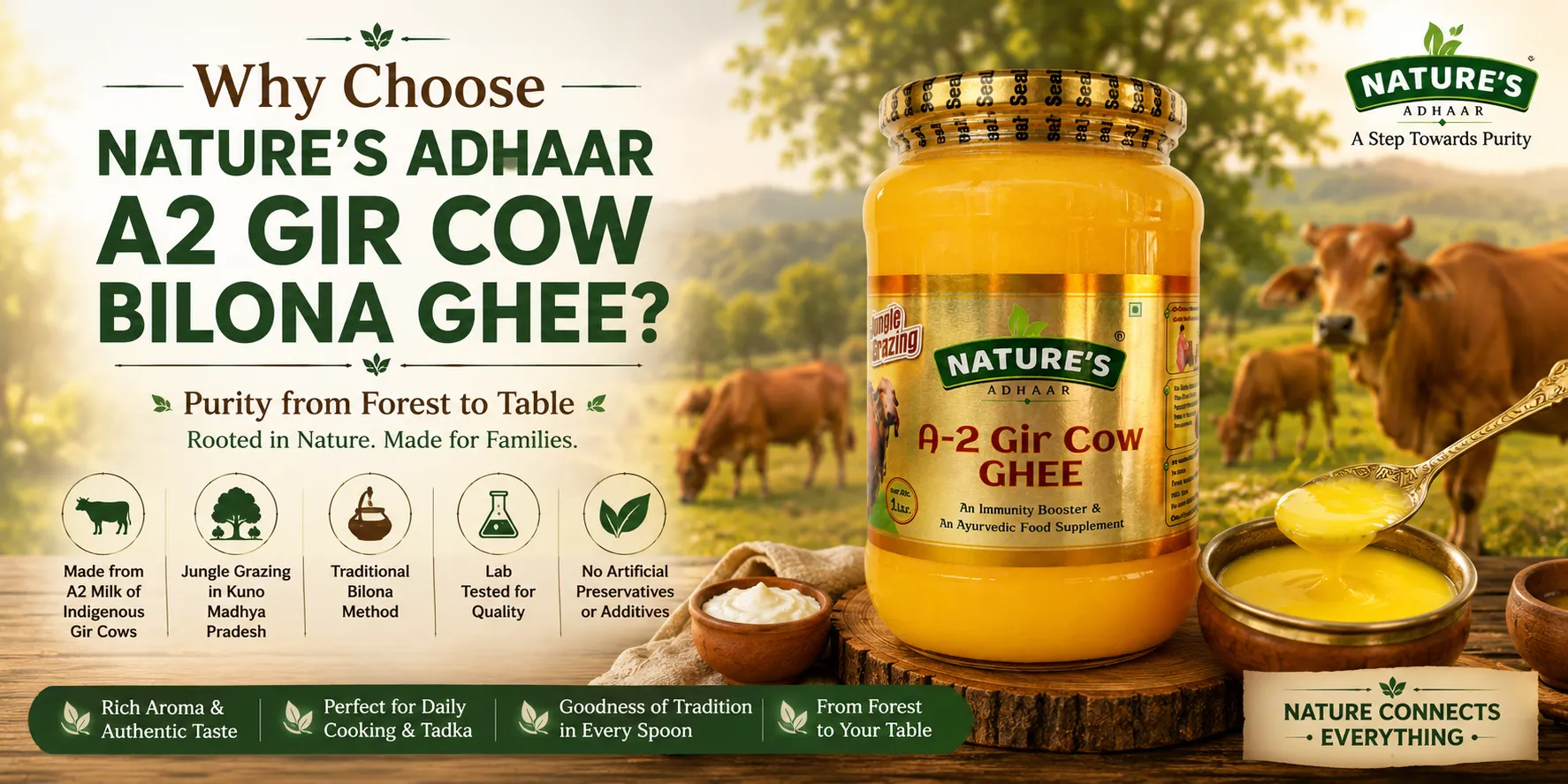
Nature’s Adhaar approaches ghee from a source-to-jar perspective.
Our focus includes:
Indigenous Gir Cows
Milk sourcing is associated with Gir cows.
Jungle Grazing Philosophy
Our sourcing story is connected with Gir cows grazing in the natural surroundings of Kuno, Madhya Pradesh.
Traditional Bilona Preparation
We focus on the traditional curd-to-butter-to-ghee method.
No Artificial Preservatives
Our product is made without artificial preservatives.
Quality Focus
Careful processing and quality testing are part of our approach.
Traditional Taste & Aroma
Our objective is to preserve the characteristic sensory experience associated with traditionally prepared ghee.
This combination represents the Nature’s Adhaar philosophy:
Purity from Forest to Table.
Final Thoughts
A2 Gir Cow Bilona Ghee represents more than simply another cooking fat for consumers interested in traditional Indian food practices.
Understanding where the milk comes from, how the cows are managed, how the ghee is prepared and how product quality is maintained can help you make a more informed purchase.
Whether you use ghee for tadka, rotis, khichdi, traditional sweets or occasional cooking, focus on quality, transparency and appropriate consumption.
At Nature’s Adhaar, our approach combines Jungle Grazing Gir cows, traditional Bilona preparation and quality-focused processing with the aim of bringing traditional ghee from its natural source to your family table.
Nature’s Adhaar — Nature Connects Everything.

Leave a Reply